On this page
The detail
For what is in the test, see what's in the NSW Selective test. For why there is no minimum score, see NSW Selective cut-off marks.
Facts
What are the key facts and figures?
The key figures are the 2025 applications, sitters and places, plus the confirmed dates for 2028 entry.
| Fact | Detail | Official source |
|---|---|---|
| Applications, 2025 test | 17,559 | Independent Review, July 2025, Appendix 3, Table 1 |
| Students who sat, 2025 test | 15,576 | Independent Review, July 2025, Appendix 3, Table 1 |
| Year 7 places, 2025 cycle | 4,227 (chart label 4227) | Independent Review, July 2025, Appendix 3, Figure 1 |
| Applications per place | "Nearly 4" on average, 2020 to 2025 | Independent Review, July 2025, executive summary |
| Share gaining a place | "A quarter of students" | Outcomes page video (page updated 5 Aug 2026) |
| Places for 2027 entry | 4,338 Year 7 places; 17 fully and 27 partially selective schools; 90 Aurora College places | Selective high schools (updated 10 Sep 2026) |
| Minimum entry score | None set; no pass or fail mark | Outcomes page |
| 2028 entry dates (test sat in 2027) | Applications open Thursday 5 November 2026 and close Monday 15 February 2027; test Thursday 13 or Friday 14 May 2027; make-up test Friday 11 June 2027 | Key dates page, NSW Department of Education, published 27 and 28 Oct 2026 |
Sitters
How many students sit the selective test?
About 15,576 students sat the 2025 test, from 17,559 applications. The department does not put a candidature number on its main selective pages, so the clearest official figures sit in the appendix of the Independent Review of the 2025 Opportunity Class and Selective High School Placement Testing by Dr Michele Bruniges, published by the department. The review's executive summary says that "on average across 2020-2025, there were nearly 4 applications for every Year 7 SHS entry place".
The table shows the review's Figure 1 figures. The year is the year the test was sat; students start Year 7 the following year. The last column is our own arithmetic.
| Test year (entry year) | Applications | Year 7 places | Applications per place |
|---|---|---|---|
| 2021 (2022 entry) | 16,347 | 4,247 | About 3.8 |
| 2022 (2023 entry) | 15,660 | 4,247 | About 3.7 |
| 2023 (2024 entry) | 17,198 | 4,247 | About 4.0 |
| 2024 (2025 entry) | 18,545 | 4,247 | About 4.4 |
| 2025 (2026 entry) | 17,559 | 4,227 | About 4.2 |
| 2026 (2027 entry) | Not published (as at 26 Oct 2026) | 4,338 listed | Not available |
Applying is not the same as sitting
Not every applicant turns up. In 2025, 17,559 applications were received but 15,576 students sat the test on any date. That gap is 1,983 students, about 11 in every 100 applicants, so the honest answer for the latest published year is about 15,600 sitters.
The 2025 test was an unusual year: disruption at three large Sydney venues meant many students sat a rescheduled test later in May. The counts above include everyone who sat on any date.
Places
How many selective school places are there in NSW?
There are 4,338 Year 7 selective places for 2027 entry. The department's selective high schools page (updated 10 September 2026) lists:
- 4,338 Year 7 places across selective high schools.
- 17 fully selective and 27 partially selective high schools for Year 7 entry.
- 90 Aurora College places (45 for boys, 45 for girls), a virtual selective option for rural and remote students.
Places differ a lot by school. On the same page, for example, Sydney Boys High and Sydney Girls High each list 180 Year 7 places, North Sydney Boys and North Sydney Girls 150 each, James Ruse 120 day places (60 boys, 60 girls) and Girraween 120 (60 boys, 60 girls). A smaller school with heavy demand is harder to get into than the statewide ratio suggests. Our NSW Selective and OC school list sets out every school's places by gender.
Odds
What do the odds mean, and what do they not?
The odds are about 27%, or roughly 1 place for every 3.7 students who sat in 2025. The department rounds this to "a quarter". That is a fair picture of the whole system, but it is not your child's personal chance, for three reasons.
Your school choices matter
You list 1 to 3 selective schools in order. Your child receives one initial offer, from the highest choice they qualify for. Demand is not spread evenly, so a place somewhere is more likely than a place at one particular school.
Results are relative
There is no pass mark. Each place goes to the strongest applicants for that school, so the score needed shifts with each school, each year and each cohort. That is why published cut-offs are only estimates.
Offers keep moving
Some families decline offers, and reserve lists can produce offers up to the end of Term 1 of the entry year. The department is clear that a reserve list is not a guaranteed offer.
One more way to see it: the Performance report places each child in one of four bands per section (top 10%, next 15%, next 25%, lowest 50% of candidates). Offers are made on the combined result and school choices, and the department does not publish which band mix leads to an offer. See what NSW Selective performance bands mean.
Difficulty
Is the selective test hard, and what makes it hard?
Yes, for most children, and that is deliberate. The department's practice tests page says the questions "draw upon concepts from the NSW curriculum up to Year 6", and that Thinking Skills needs no previous knowledge. A student in the department's own video puts it simply: "it is a selective test after all so the questions are supposed to be hard". What makes it hard is less the content than the conditions:
- Time pressure. Mathematical Reasoning is 35 questions in 40 minutes, Thinking Skills 40 questions in 40 minutes, Reading 17 questions (some with several parts) in 45 minutes, and Writing one task in 30 minutes.
- Writing counts as much as maths. Writing is 25% of the Selective test, and it is typed on a computer.
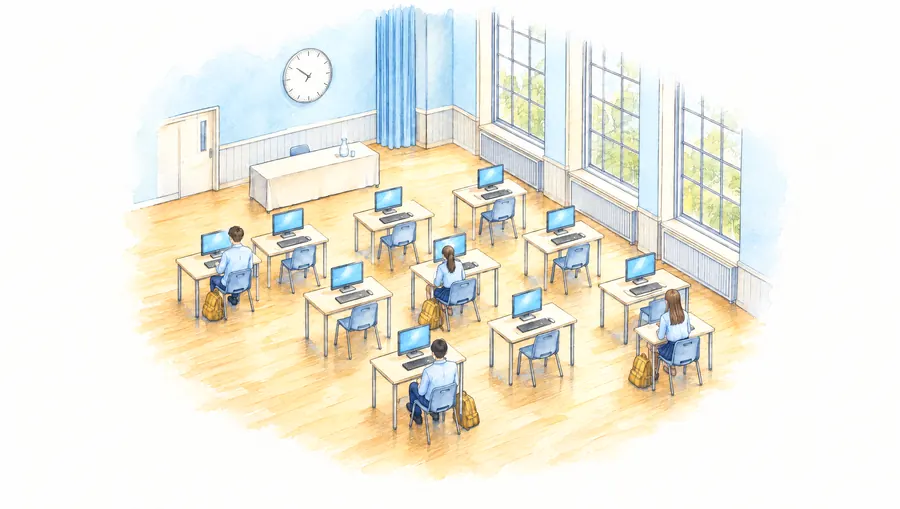
- No calculator, on screen. The test is computer-based, on department computers, and held only in NSW from 2026.
- One sitting. Each student is allocated one test day. A make-up test exists only for approved illness or misadventure.
- Strong company. Many candidates are used to topping their class. Being in the lowest 50% band for a section is not failing; half of all candidates are in that band by design.
How long is the selective test? The four sections add up to 2 hours 35 minutes of working time, before any breaks and instructions. For a section-by-section guide, see what's in the NSW Selective test.
Is the selective test much harder than the OC test?
On places alone, the opportunity class test is tighter. The same review shows 11,458 students sat the OC test in 2025 for 1,840 places, and the department's outcomes video says "only about one in eight students are successful in gaining a place in an opportunity class". Selective is the longer, older-age test with typed Writing, so the two are different challenges rather than one harder copy of the other. For the OC side, see the NSW OC test and HPGE vs opportunity class vs Selective.
What is the hardest part of the selective test?
The department does not say which section students find hardest, and it differs by child. Practise each section under real timing to see which needs work first. Our guides to how the four sections combine and helping a child finish on time go further.
Is the selective test harder than it used to be, and can you get in without tutoring?
The department publishes no year-on-year measure of question difficulty, but competition has been steady at roughly 3.7 to 4.4 applications per place (see the table above). On tutoring, the department says it is not necessary and offers free practice tests; see preparing for Selective at home and free NSW Selective practice tests.
Next steps
What does this mean for my family?
A one-in-four system rewards calm, early planning more than last-minute effort:
- Choose schools with the numbers in front of you. Look at each school's places and travel time, and order your 1 to 3 choices by where your child would genuinely go.
- Practise under real conditions. The department's free practice tests show the real timing and screen. The department says coaching or tutoring "is not necessary", so decide what extra help, if any, suits your child.
- Give Writing a weekly slot. At 25% of the mark it is too big to leave until the last month.
- Have a Plan B you are happy with. Partially selective schools, reserve lists, scholarships and later-year entry are all real routes. See Plan B options if you miss out and can you retake the Selective test?
- Talk about it as a stretch, not a verdict. Most children who sit will not receive an offer, and that says nothing final about high school.
Frequently asked questions
How hard is the selective test?
It is built to stretch high-potential Year 6 students, and places are limited. In 2025, 15,576 students sat the test for 4,227 Year 7 places, so about 27 in every 100 who sat could be placed. The NSW Department of Education describes it as about a quarter of students gaining a place.
How many students sit the selective test?
In 2025 (for Year 7 entry in 2026), 17,559 applications were received and 15,576 students sat the test, according to the department's independent review. We could not find a published figure for the May 2026 test as at 26 October 2026.
How many people take the selective test compared with places?
The department's review says that, on average from 2020 to 2025, there were nearly 4 applications for every Year 7 selective place. In 2025 it was about 4.2 applications per place, or about 3.7 students who sat the test per place.
How many selective school places are there in NSW?
The department lists 4,338 Year 7 places across 17 fully selective and 27 partially selective high schools, plus 90 Aurora College places for rural and remote students (page updated 10 September 2026).
Is there a pass mark for the selective test?
No. The department says there is no pass or fail mark and no set minimum entry score. Offers are based on test performance and your order of school choices, so the score needed changes with each school and each year.
Is the selective test much harder than the OC test?
Not in the sense of one being simply harder. Selective is sat in Year 6 on content up to Year 6, so it is pitched at an older group, while OC is sat earlier. On places alone, OC is tighter: in 2025, 11,458 students sat the OC test for 1,840 places, and the department's outcomes video says only about one in eight students gain an opportunity class place, compared with about a quarter for selective high schools.
Can you retake the selective test?
Not for Year 7 entry. Each student sits the test in Year 6 and is allocated one test day, with a make-up test only for approved illness or misadventure. Later entry in Years 8 to 11 is through each school's own vacancy process.
Can my child get into selective without tutoring?
The department says coaching or tutoring for the placement test is not necessary, and it provides free practice tests. We could not find a published figure for how many offers go to students who did or did not have tutoring, so we cannot put a number on it. Families decide for themselves how much extra preparation suits their child.
Is the selective test harder than it used to be?
The department does not publish a measure of how difficult the questions are from year to year, so we cannot say the questions have become harder. What the official figures show is competition: about 3.7 applications per place for the 2022 test (2023 entry), about 4.4 for 2024 (2025 entry) and about 4.2 for 2025 (2026 entry). The test is also computer-based and held only in NSW from 2026.
Does tutoring make selective tests unfair?
The department says coaching or tutoring for the placement test is not necessary, and it provides free practice tests so any family can see the real timing and screen. It also runs the Equity Placement Model, which holds up to 20% of places at each school for students from under-represented groups. Families hold different views on extra tutoring, so check the department's fair access page for how places are allocated.
What is the hardest part of the selective test?
The department does not publish which section students find hardest, and it differs from child to child. What makes the test hard is mostly the conditions: Mathematical Reasoning is 35 questions in 40 minutes, Thinking Skills 40 questions in 40 minutes, Reading 17 questions in 45 minutes, and Writing is one typed task in 30 minutes worth 25% of the Selective test. Practice tests under real timing show which section needs work first.
- 30 Oct 2026: Confirmed the 4,227 places figure from the department's Independent Review (Appendix 3, Figure 1) and made the source clear in the opening answer and body.
- 30 Oct 2026: Added the confirmed 2028-entry dates from the NSW Department of Education, with a link to the key dates.
- 30 Oct 2026: Rewrote the opening answer, added a key facts table and question headings.
- 26 Oct 2026: First published as a draft.
Official sources
Official pages checked 26 October 2026. If this page and the department differ, follow the department. If this page and an official source ever differ, follow the official source.
- Independent Review of the 2025 OC and Selective High School Placement Testing (Dr Michele Bruniges, July 2025): applications, students who sat, places, "nearly 4 applications" per place.
- Outcomes: "a quarter of students" line, no minimum entry scores, bands, reserve lists (updated 5 Aug 2026).
- Selective high schools: 4,338 places, 17 fully and 27 partially selective schools, Aurora College, per-school places (updated 10 Sep 2026).
- Fair access: gender parity from the 2027 intake, Equity Placement Model (updated 20 Feb 2026).
- Selective high school practice tests: sections, timing, weighting, coaching statement (updated 20 Mar 2026).
- Placement test: computer-based, NSW only from 2026, one test day, make-up test (updated 18 Aug 2026).
- Application process: confirmed 2028-entry dates, published 27 and 28 Oct 2026 (key dates).