On this page
- What are the key facts for 2028 entry?
- Does my child need tutoring for the selective test?
- How do online tutoring classes work for primary school kids?
- Online selective tutoring vs face to face: which is better on each factor?
- Pick-up and drop-off hassle, and tired after school: is online better than driving to a centre?
- Will my child focus in an online class? Is online group tutoring good for a child who gets distracted?
- Can kids see each other? My child is shy: will they ask questions? What if they can't type in chat?
- Can online tutors see if my child switches tabs?
- Is online or in-person tutoring better for a Year 3 OC child?
- Selective reserve list: how likely is an offer? What about a school's reserve band?
- How do I compare providers with a trial lesson?
- Frequently asked questions
- Official sources
The detail
Facts
What are the key facts for 2028 entry?
| Fact | Detail | Official source |
|---|---|---|
| Tutoring for the placement test | "Not necessary"; free resources provided (page updated 20 Mar 2026) | Practice tests |
| Test delivery | Computer-based, at a test centre, on department computers (page updated 28 Oct 2026) | Placement test |
| 2028-entry applications (Selective and OC) | Open Thursday 5 November 2026, close Monday 15 February 2027 (confirmed). Last day to request reasonable adjustments: Monday 15 February 2027 | NSW key dates |
| Selective test, 2028 entry | Thursday 13 or Friday 14 May 2027; make-up Friday 11 June 2027 (confirmed) | NSW key dates |
| OC test, 2028 entry | Tuesday 11 or Wednesday 12 May 2027; make-up Thursday 10 June 2027 (confirmed) | NSW key dates |
| Reasonable adjustments | Request in the application, with evidence, by the application closing date (page updated 26 Oct 2026) | Using the application website |
| Reserve bands, Year 7 entry 2027 | A to E: estimate by end of Sept to end of Jan; F unlikely (page updated 11 Aug 2026) | Reserve bands |
Before you compare
Does my child need tutoring for the selective test?
No, not by the department's account. Its practice tests page says: "It is important to know that coaching or tutoring for the placement test is not necessary." It also says the department "provides free resources to help your child prepare for the test", including online computer-based practice tests.
Families still choose tutoring for ordinary reasons: a regular routine, feedback on writing, someone other than a parent holding the timetable, or practice under timed conditions. If those reasons apply, format is the next question. If they do not, start with the official and free practice tests, see how your child goes, and decide afterwards. For the timing question, see when to start OC, Selective and scholarship prep.
The format
How do online tutoring classes work for primary school kids?
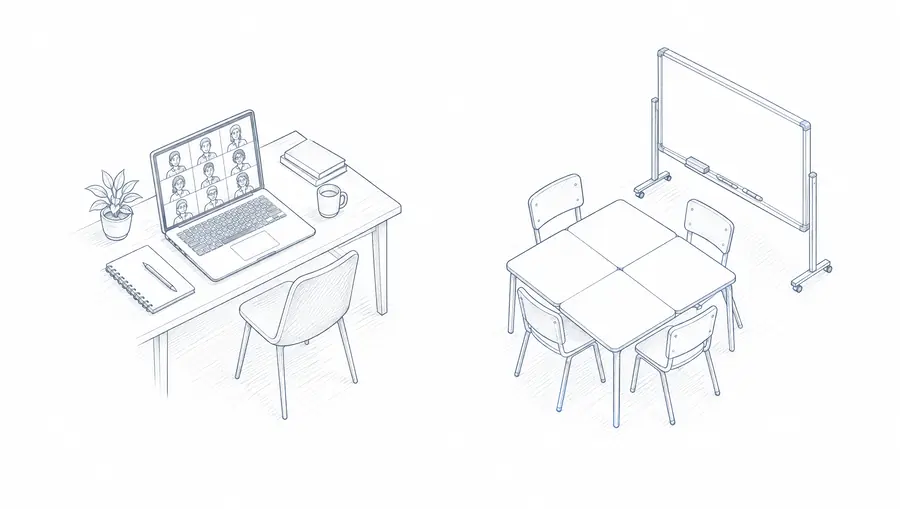
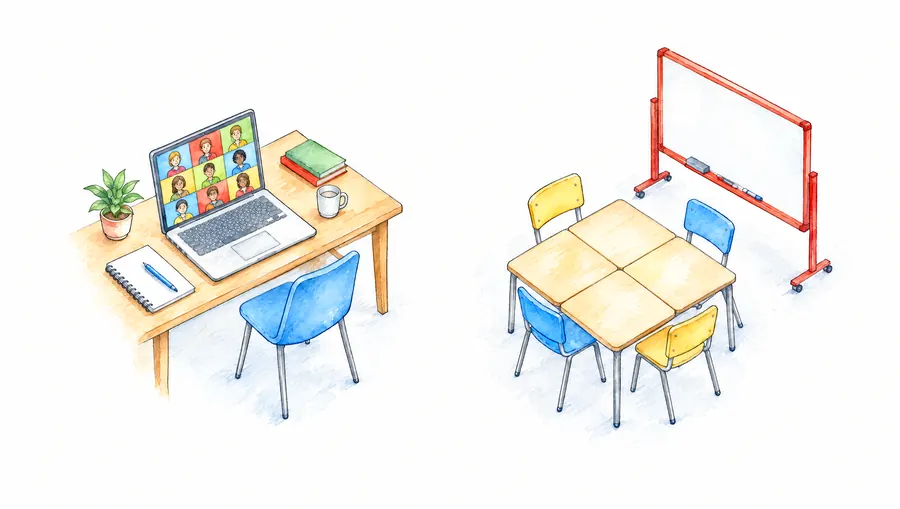
In a live online class, your child joins a scheduled video session on a laptop or tablet, and the tutor teaches, asks questions and sets timed work in real time. Scholarly's classes run on Zoom. Things to look for are a shared screen for worked examples, a way for students to answer aloud or in chat, and a short written or timed task before the end.
One real benefit of learning on a screen: the placement tests are now completed on computers, and Writing is typed. A child who is used to reading, answering and typing on a device meets less of a surprise on test day. The department's online practice tests let you see the interface for free.
For a checklist on delivery, class size, trial tests and cancellation, see Online selective tutoring in NSW: a parent checklist.
Side by side
Online selective tutoring vs face to face: which is better on each factor?
Neither wins on every factor: online wins on travel, and face to face can win on in-room redirection. "Depends" in the table means it varies by provider and child, so test it in a trial lesson.
| Factor | Online (live) | Face to face |
|---|---|---|
| Travel and time | No drive. The saved time can go to rest or homework. | Round trip each week, plus parking and waiting. |
| After-school energy | Child is already home, but still tired. Session time matters most. | A drive adds time before the lesson starts, though some children like the change of setting. |
| Focus | Depends: devices tempt some children, and others focus well on a screen. | A tutor in the room can redirect at once. Depends on group size. |
| Asking questions | Speaking, chat and private messages, if the provider offers them. | Hand up or a quiet word. Some shy children find a room harder. |
| Matching the test | Computer-based practice, including typed writing. | Depends on whether the work is on paper or on screen. |
| Parent role | Set-up, quiet space, some supervision of a younger child. | Transport and waiting. Less device supervision. |
| Peers | Depends on camera settings and class size. | Children see each other in person. |
| Cost factors | Format, group size, hours, materials, trial tests, term length. Ask for written fees. | The same factors, plus venue costs the provider may pass on. Ask for written fees. |
Logistics
Pick-up and drop-off hassle, and tired after school: is online better than driving to a centre?
If the weekly drive is what makes tutoring unworkable, online is the clear logistical win: no school-to-centre dash, no waiting in the car, and no second child to supervise elsewhere. Families with two working parents or several children often find that this alone decides it.
Online does not fix tiredness, though. A child who is flat at 5 pm will be flat on Zoom at 5 pm. Practical steps that help in either format:
- Choose the time slot your child is sharpest, such as a weekend morning, if the provider offers one.
- Allow a snack, a drink and 15 minutes to reset between school and the session.
- Keep the session length realistic for the child's age.
- Watch for a pattern. If the same session is always a struggle, ask about a different time before changing format.
See also working parents: supporting selective prep without sitting beside your child.
Attention
Will my child focus in an online class? Is online group tutoring good for a child who gets distracted?
Many primary-aged children do focus well online, and many do not, so a trial lesson is the honest test. Practical set-up that helps most children:
- A desk in a shared, quiet room, not a bedroom with toys and a bed.
- A headset, so the tutor's voice is clear and home noise fades.
- Only the class tab open. Close games, videos and messages before the session.
- Water, a pencil and paper ready, so there is no reason to leave the seat.
- A parent nearby, not hovering, for the first few sessions.
Group size matters more than format. A small group where every child is asked something every few minutes holds attention better than a large one, and a child who needs constant one-to-one prompting may find any group hard.
If distraction worries you beyond tutoring, speak to your GP, paediatrician or school counsellor. For the test itself, the application website has a step for reasonable adjustments for students with disability or a medical condition. The department says requests must be made in the application, with supporting evidence, by the application closing date. Related reading: group class or one on one selective prep.
Taking part
Can kids see each other? My child is shy: will they ask questions? What if they can't type in chat?
Usually yes, if the provider offers more than one way to take part, and what children can see depends on the provider's settings.
Can kids see each other in an online selective class?
It depends on the provider. Some classes show every camera, some show only the tutor, and some let students choose. Ask what children can see and hear, whether sessions are recorded, and whether chat messages are public to the class.
My child is shy: will they ask questions in an online class?
Some shy children find a screen easier because they are not in a room full of faces. Others go quiet. Ask whether students can speak, type, send a private message or use a simple hand-raise or thumbs-up signal. A good tutor invites questions in several ways and checks in with quieter students by name.
My child can't type questions in the chat in an online class
That is common in younger children, and it is fixable. Ask whether your child can unmute and speak, or send a short private message instead. A parent can also type for them in early sessions. In the longer term, short regular typing practice helps in either format, because the Selective Writing section is typed on a department computer.
Supervision
Can online tutors see if my child switches tabs?
Possibly, but we could not confirm this from an official source, so we will not guess. What a tutor sees depends on the platform and its settings. A tutor can normally see a child's video if the camera is on, hear them and watch their answers. Whether a tutor can see tab switching varies, so ask the provider directly and do not assume.
The reliable fix sits at home. Close other tabs and apps before the session, keep the device in a shared room, and agree on a simple rule before class begins.
Younger children
Is online or in-person tutoring better for a Year 3 OC child?
Either can work, but younger children usually need more adult help with online classes, such as joining the link, unmuting and keeping the right tab open. In person, a tutor can see what a young child's hands and face are doing, which helps with fidgeting and frustration. Online, a parent nearby can bridge that gap.
Children in Year 3 now sit the Opportunity Class placement test later, in Year 4. See Year 3 now: a term-by-term OC plan for a calm timeline. At this age, many families start with free practice and good reading habits before adding any class.
Offers
Selective reserve list: how likely is an offer? What about a school's reserve band?
An offer is likely but not certain in bands A to E and unlikely in band F, and the tutoring format does not change a reserve position. Offers come from the school's reserve list when other families decline. The department's reserve bands page (updated 11 August 2026, covering Year 7 entry in 2027) defines the bands as estimates based on the previous year:
| Band | Estimate based on previous year |
|---|---|
| A | By the end of September |
| B | By the end of October |
| C | By the end of November |
| D | By the end of December |
| E | By the end of January |
| F | Unlikely to receive an offer. If one comes, it would probably be after the school year starts. |
Bands A to E make an offer likely but not certain, because they depend on other families declining. Offers continue "up until the end of Term 1 2027, should vacancies arise". The department's page does not list a band per school: the band for each school appears in your child's application dashboard, so check there.
More detail: how offers and reserve lists actually move and Hornsby Girls High School Year 7 entry.
How to choose
How do I compare providers with a trial lesson?
Try one lesson in each format and score it against the six checks below.
Try one lesson in each format. Watch how your child behaves in the last ten minutes, not the first.
Ask about interaction. How do quiet children speak, and how often does each child answer?
Ask about privacy. Cameras, recording and chat visibility.
Ask about feedback. Is writing marked, explained and returned?
Ask for written fees. Compare format, group size, hours, materials, trial tests and term length.
Check the exit. Ask about cancellation and what happens if your child misses a session.
More on questions to ask and warning signs: how to choose a selective tutor.
Frequently asked questions
Online selective tutoring vs face to face: which is better?
Neither is better for every child. Online saves travel and suits busy afternoons, and the Selective test itself is computer-based. Face to face can suit a child who struggles to stay on task on a screen. Try a trial lesson and judge by your child's attention and progress, not the format.
Does my child need tutoring for the selective test?
No. The NSW Department of Education says coaching or tutoring for the placement test is not necessary, and it provides free preparation resources. Tutoring is a family choice for structure, feedback or accountability.
Will my child focus in an online class, and is online group tutoring good for a child who gets distracted?
Many primary children focus well with a quiet spot, a headset, a clear start and finish time and no other tabs or games open. A child who needs constant one-to-one prompting may find any group format hard, online or in person. Ask for a trial lesson, and if attention is a wider concern, talk to your GP, paediatrician or school counsellor.
Can kids see each other in an online selective class?
That depends on the provider's settings. Some classes show every camera, some show only the tutor, and some let students choose. Ask before enrolling what children can see, whether sessions are recorded and whether chat is public or private.
My child is shy: will they ask questions in an online class?
Often yes, if the tutor offers more than one way to ask, such as speaking, typing in chat, a private message or a hand-raise signal. Ask the provider how quieter students are included. A trial lesson shows quickly whether your child feels comfortable.
My child can't type questions in the chat in an online class. What can we do?
Ask whether your child can unmute and speak instead, or send a short private message. Typing is also worth practising anyway, because the Selective test is computer-based and the Writing section is typed.
Can online tutors see if my child switches tabs?
We could not confirm this from an official source. What a tutor can see depends on the platform and its settings, so ask the provider directly. At home, closing other tabs and keeping the device in a shared room is the most reliable fix.
Selective reserve list: how likely is an offer?
The department says bands A to E mean an offer is likely, but not certain, by the end date shown, and band F means an offer is unlikely. Bands are estimates from last year's declines, so check the band shown next to the school in your application dashboard.
- 30 Oct 2026: Added the confirmed 2028-entry dates from the NSW Department of Education: applications from Thursday 5 November 2026 to Monday 15 February 2027, the Selective test on Thursday 13 or Friday 14 May 2027 (make-up Friday 11 June 2027) and the OC test on Tuesday 11 or Wednesday 12 May 2027 (make-up Thursday 10 June 2027).
- 30 Oct 2026: Linked the dates to the department's key dates page.
- 30 Oct 2026: Rewrote the opening answer, added a key facts table and question headings.
- 26 Oct 2026: First published as a draft.
Official sources
Pages checked 30 October 2026. If this page and an official source ever differ, follow the official source.
- Selective high school practice tests: coaching statement, free resources, computer-based format.
- Placement test: computer-based, test centres.
- Using the application website: reasonable adjustments.
- Selective high school Year 7 reserve list bands: bands A to F.
- Application process: key dates.
- Online computer-based practice tests: official, free.
- Application website: dashboard and bands.