On this page
- What are the key facts for 2028 entry?
- What should I expect in a scholarship exam?
- What type of questions are asked in a scholarship exam?
- How does the scholarship exam change for Year 5, Year 7 and Year 9?
- How do ACER, EduTest and AAS differ?
- What should I study for a scholarship exam?
- What happens on the day?
- What happens after the exam?
- Frequently asked questions
- Official sources
Key dates
What are the key facts for 2028 entry?
For 2028 entry, the ACER cooperative test is Saturday 27 February 2027, and applications close at midnight AEDT on Sunday 7 February 2027.
| Fact | Detail | Official source |
|---|---|---|
| ACER applications open | Monday 21 September 2026 | ACER |
| ACER applications close (cooperative: Qld, NSW, NT, WA, Vic) | Midnight AEDT, Sunday 7 February 2027 | ACER |
| ACER cooperative test | Saturday 27 February 2027 | ACER |
| ACER alternative-date schools | Each school picks its own date | ACER participating schools |
| EduTest and AAS dates | Set by each school. Check the school's scholarship page | EduTest, AAS |
| Results and offers | Not stated by ACER for 2027. Schools contact parents directly | ACER |
| NSW Selective test, 2028 entry | Thursday 13 or Friday 14 May 2027. Applications open Thursday 5 November 2026 and close Monday 15 February 2027 | NSW Department of Education |
Dates for individual schools differ, and some close earlier than ACER does. Our school-by-school lookup shows which test each school uses.
The short version
What should I expect in a scholarship exam?
Expect a morning of timed papers, mostly multiple choice, plus one writing task, which a school uses to rank applicants for an academic scholarship. ACER says its tests are "designed to rank applicants, finely differentiating the top end of performance", and they look beyond recall to critical and higher-order thinking (ACER scholarships page). In practice, most families will see this pattern:
- One morning of timed papers, mostly multiple choice, plus one writing task.
- Questions on texts and problems your child has not seen before, not on a fixed syllabus.
- No calculators, phones, watches or rulers in the room (ACER parents page; AAS).
- A test chosen by the school. The same child can face ACER at one school and EduTest or AAS at another.
Question types
What type of questions are asked in a scholarship exam?
The questions test reading, mathematics, reasoning, humanities and writing, though names differ by provider and the skills repeat. This is a plain-English guide, not a list of official questions.
| Skill | What it looks like | Where it appears |
|---|---|---|
| Reading | Read passages (and, for ACER Primary, images) and answer questions on meaning and purpose. | ACER Reading and Viewing; EduTest Reading Comprehension; AAS reading comprehension |
| Mathematics | Multi-step problems that test reasoning, with no calculator. | All three providers |
| Reasoning | Verbal and numerical reasoning questions that test thinking more than school content. | EduTest Verbal and Numerical Reasoning; AAS reasoning |
| Humanities | ACER lists it for Levels 1 to 3 but does not break it down on the parent page. Use ACER's practice material to see the style. | ACER Levels 1 to 3 |
| Writing | A planned piece in any suitable form, such as a story or persuasive piece. It must show original thought, not a pre-prepared piece. | All three providers |
Sources: ACER scholarships page, ACER parents page, EduTest, AAS. For the writing paper, ACER says length matters less than the thought and expression, and students should spend a couple of minutes planning. Our guide to ACER written expression goes deeper.
By year level
How does the scholarship exam change for Year 5, Year 7 and Year 9?
The exam changes with the year your child is entering, and ACER uses Primary, Level 1 and Level 2 to show how (ACER scholarships page).
| Entering | ACER level | Sections | Delivery |
|---|---|---|---|
| Year 5 (or 4, 6) | Primary | Reading and Viewing, Mathematics, Writing | Paper |
| Year 7 (or 8) | Level 1 | Written Expression, Humanities, Mathematics | Online or paper |
| Year 9 (or 10) | Level 2 | Written Expression, Humanities, Mathematics | Online or paper |
Year 5 scholarship exam. ACER's participating schools list shows the Primary level at ten NSW listings, so far fewer schools test at this age. See Year 5 scholarship exams in Sydney.
Scholarship exam for Year 7. This is the busiest entry point for Sydney families, and it falls in the same season as the Selective test. Compare the two in Selective test vs ACER scholarship test.
Year 9 scholarship exams. The pattern matches Level 1 at a higher standard. Which schools offer Year 9 places varies, so read Year 9 scholarships at Sydney private schools.
Format
How do ACER, EduTest and AAS differ?
They differ in the papers set, the timing and how the test is delivered, as the table shows.
| Provider | Papers | Timing | Delivery |
|---|---|---|---|
| ACER | Primary: Reading and Viewing, Mathematics, Writing. Levels 1 to 3: Written Expression, Humanities, Mathematics | Not stated on ACER's parent page | Primary on paper. Levels 1 to 3 online or paper |
| EduTest | Verbal Reasoning, Numerical Reasoning, Reading Comprehension and Mathematics (all multiple choice), plus Written Expression | 30 minutes per multiple-choice paper. Written Expression 15 minutes with no planning or reading time | School chooses paper or online |
| AAS | Writing, reading comprehension, mathematics, reasoning. Four or five answer options. Wrong answers not penalised | 40 to 50 minutes in two sessions with a 20-minute break. Writing 25 to 30 minutes | School chooses pen and paper or online |
Sources: ACER scholarships page, EduTest, AAS. Question counts and the year levels each EduTest battery targets are not stated on those pages, so we have left them out. Our AAS vs ACER vs EduTest vs HAST guide explains which is which.
Preparation
What should I study for a scholarship exam?
Study reading, maths reasoning and planned writing, because there is no fixed syllabus to memorise. ACER's practice materials are meant to familiarise students with question types, not for intensive drilling (ACER parents page). Scholarly's suggestions:
- Writing first. One planned piece a week, in different forms, with feedback. Practise a two-minute plan.
- Reading. Varied non-fiction, fiction and image-based material, then talk about what the author meant.
- Maths reasoning. Multi-step word problems done mentally or on paper, because calculators are not allowed.
- Reasoning. Patterns, number sequences and word relationships if the school uses EduTest or AAS.
- Stamina. A few timed practice runs, after untimed ones, so a morning of papers is not new.
ACER says no past papers are available for purchase, and it sells practice tests and practice questions instead (ACER parents page). See ACER scholarship past papers for what is legitimate. Practice material and tutoring are optional, and the right amount depends on your child.
Test day
What happens on the day?
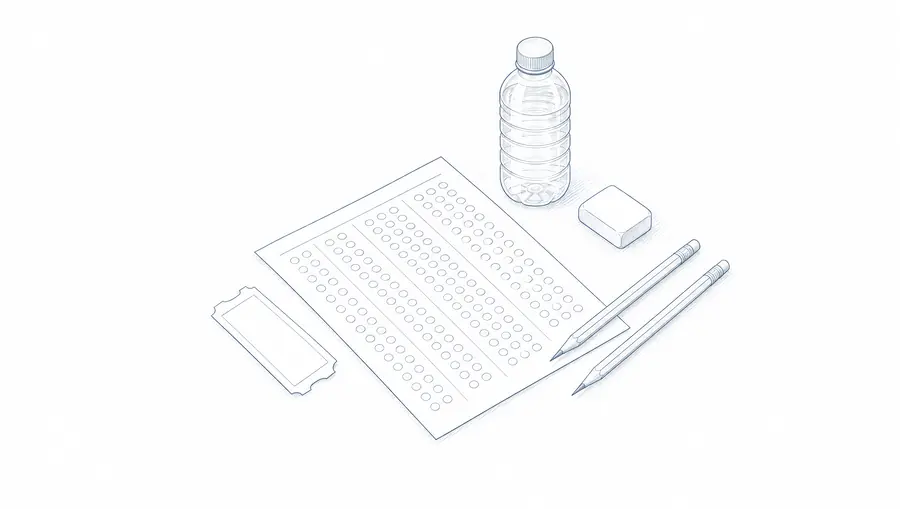
Your child brings pens, pencils and an eraser, and leaves calculators, phones and watches out of the room.
- ACER: bring two blue or black pens (Written Expression), two HB or B pencils (multiple choice), an eraser and optional food or drink for the break (ACER parents page).
- ACER: do not bring rulers, books or papers, calculators, watches, phones, recording equipment or compasses and dividers (ACER parents page).
- AAS: two blue or black pens, food and drink for the break, and the invoice and ID if the school asks. Bags and smart watches are not allowed (AAS).
- Arrival time and venue come from the school or provider, so follow their email, not a general guide.
After the exam
What happens after the exam?
For ACER cooperative sittings, ACER sends results to the schools you applied to and you can view them in your Parent Account. For alternative-date sittings, each school decides whether and how results are reported. Schools contact parents directly to offer scholarships (ACER parents page).
A high score does not guarantee a scholarship, and some schools add an interview. See scholarship interviews at Sydney private schools. EduTest says most schools are part of its results transfer process, though some are not (EduTest parents), and AAS results cannot be shared between schools unless they are in a scholarship co-op (AAS).
Frequently asked questions
What should I study for a scholarship exam?
Reading closely, maths reasoning without a calculator, and planned writing. ACER says its practice materials are meant to familiarise students with question types, not for intensive drilling (ACER). Start with a weekly planned piece of writing and varied reading.
What type of questions are asked in a scholarship exam?
Mostly multiple-choice questions on reading, mathematics and reasoning, plus one writing task. AAS says its questions have four or five options and wrong answers are not penalised (AAS). The writing task is long-form.
What is a scholarship exam for Year 7?
It is a school-chosen test used to rank applicants for an academic scholarship. For Year 7 entry ACER offers Level 1, with Written Expression, Humanities and Mathematics (ACER). The school decides who is offered a scholarship.
Is there a Year 5 scholarship exam?
Some schools test for Year 5 entry. ACER's Primary level is for entry to Years 4, 5 or 6 and is paper based, with Reading and Viewing, Mathematics and Writing (ACER). Check which schools offer a Year 5 scholarship.
Are there Year 9 scholarship exams?
Yes. ACER's Level 2 is for entry to Year 9 or 10, with the same section pattern as Level 1: Written Expression, Humanities and Mathematics (ACER). Fewer schools offer Year 9 places than Year 7, so check each school.
Are there scholarship exam past papers?
ACER says no past papers are available for purchase. It sells practice tests and practice questions that use the same subtests and question formats as the real test (ACER parents page). Treat unofficial PDFs with caution.
How long is a scholarship exam?
What should my child bring to a scholarship exam?
For ACER: two blue or black pens, two HB or B pencils, an eraser and optional food or drink. Calculators, phones, watches, rulers and books are not allowed (ACER parents page). Your school's invitation may add items, so check it.
- 30 Oct 2026: Added the confirmed 2028-entry NSW Selective test dates from the NSW Department of Education.
- 30 Oct 2026: Added a breadcrumb trail, a byline, links to related guides and a next step to a free trial class.
- 30 Oct 2026: Rewrote the opening answer, added a key facts table and question headings.
- 26 Oct 2026: First published as a draft.
Official sources
Official links, checked 26 October 2026. If this page and an official source ever differ, follow the official source.